Your First Race Week, Planned Backwards
Plan your first race week backwards from the start line, so ordinary commitments, race-day essentials and arrival time have room in your schedule.
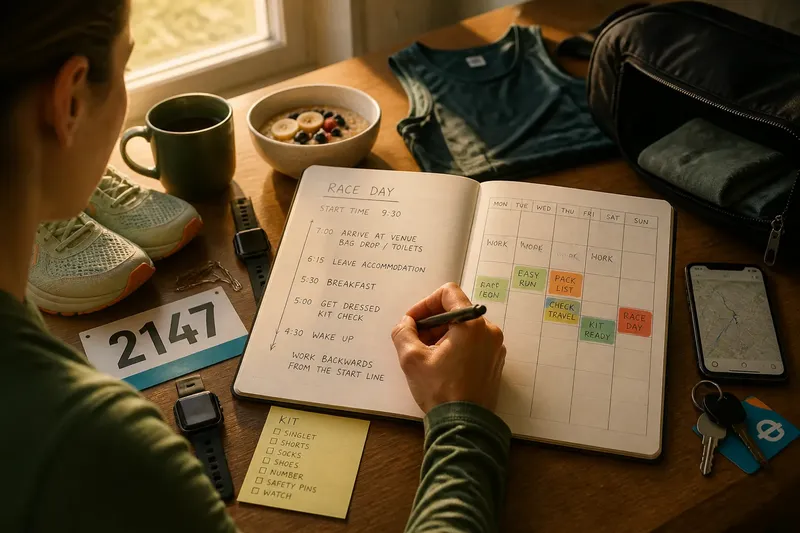
Your first race week is easier to manage when you plan backwards from the start line, rather than trying to squeeze every detail into the final day. Begin with the time you need to be at the venue, then work back through travel, meals, work and home commitments, leaving a little breathing room where plans can change.
What should your backward plan start with?
Write down the race’s published start time and the time runners are expected to arrive. Check the organiser’s information for the location of the start, bag-drop arrangements, road closures and any required check-in. These details set the shape of your morning more reliably than a guess based on how long the race itself takes.
Next, mark the point at which you need to leave home or your accommodation. Allow for the journey you actually expect to make, including parking, public transport connections or walking from a drop-off point. If someone is driving you, agree on a meeting place and a backup way to contact each other.
Now put those fixed points on a calendar and move backwards. Add the time you need to dress, eat what usually sits well before a run, and gather your race kit. You are building a sequence of decisions, not a tightly packed timetable.
Which kind of week are you planning around?
What if work is the main constraint?
If your shifts or meetings take up most of the week, fit preparation into the gaps that already exist instead of relying on a free evening that may not appear. Set out kit before work, and place any final errands near a regular journey. Keep the evening before the race clear of optional tasks where you can.
What if you are travelling to the event?
If the race is away from home, decide first whether you need to stay overnight or can make the journey on race morning without rushing. Check the route to the venue and identify a simple alternative if your planned transport is disrupted. Pack from a written list before travelling, rather than depending on shops near the start.
What if home or caring duties shape the week?
If you share childcare, household tasks or other responsibilities, tell the people involved what time you need to leave and when you expect to be back. Agree who is handling the morning essentials, such as breakfast or the dog’s walk. A clear handover is more useful than hoping everyone remembers the plan.
What if the event details are still unclear?
If you cannot yet confirm the start location, bag-drop rules or arrival window, leave those parts flexible and check the organiser’s updates before finalising travel. Avoid making non-refundable arrangements around an assumption you can verify later. Once the missing detail is settled, add it to the same calendar as your other commitments.
How much should you put on the calendar?
Separate fixed commitments from tasks you can move. A work shift, booked train or school pick-up belongs in the fixed column; laying out clothes, collecting a race number or preparing a familiar snack may be movable. This makes it easier to see where the week is genuinely crowded.
Give preparation tasks a home on the calendar, but do not fill every spare space. Leave room for ordinary delays and for the possibility that you will want a quieter evening than expected. If your week already feels full, simplify errands rather than turning each day into a race-related project.
- Confirm the start time, start location and arrival instructions.
- Check how you will travel there and where you will leave any vehicle.
- Set aside your running clothes, shoes and any weather-appropriate layer.
- Locate your race number, entry information and any required identification.
- Decide what familiar food and drink you can take or obtain.
- Agree on meeting and contact arrangements with anyone coming with you.
- Choose a departure time that includes the walk from transport or parking to the venue.
For event-specific requirements, follow the organiser’s information and the instructions on any product you plan to use; local transport or access rules may also affect your arrangements.
What can you leave out of race week?
Race week does not need a special project for every day. Keep training, food and routines within what you already know suits you, and avoid adding unfamiliar tasks simply because the event is close. The useful work here is logistical: knowing where you need to be and having the essentials ready.
Say you work late on the evening before a local race and usually take the bus. You could put your kit and race information by the door before work, check the first suitable bus, and ask a friend to be your backup lift; the expected result is a simpler departure with fewer decisions left for the morning.
How do you make race morning feel less rushed?
Plan from arrival backwards, not from the moment the gun goes off. Include the walk from the station or car park, time to find the toilets or bag drop, and a little space to locate your start area. A venue map can help you identify which entrance or landmark to aim for.
Keep essentials together in one place: running kit, race number, safety pins if needed, travel details and a charged phone. Put anything you must not forget—such as a door key or travel card—beside that bundle, rather than inside a bag you may leave behind. If you are carrying a bag, check the event’s rules before packing it.
Choose a meeting point with your supporters that is easy to describe and away from the busiest part of the start. Agree what happens if you do not see each other straight away. That small arrangement can prevent a last-minute search when people are moving in different directions.
What should change if the plan changes?
A backward plan is a guide, not a promise that every detail will stay fixed. If transport shifts or a family commitment moves, protect the essential chain: reach the venue, meet the organiser’s arrival requirements, and have the required race items with you. Move optional errands or simplify the journey before cutting the time needed to get oriented.
If you discover that your original plan depends on an uncertain connection, choose a more dependable option where practical or ask the organiser about access information. Keep the alternative written down so you do not have to invent one while getting ready.
Your first race week works best when the start line is the anchor and the rest of the calendar is arranged around it. Keep the plan visible, share the parts that affect other people, and leave a small margin for the ordinary surprises that make a week feel human.